
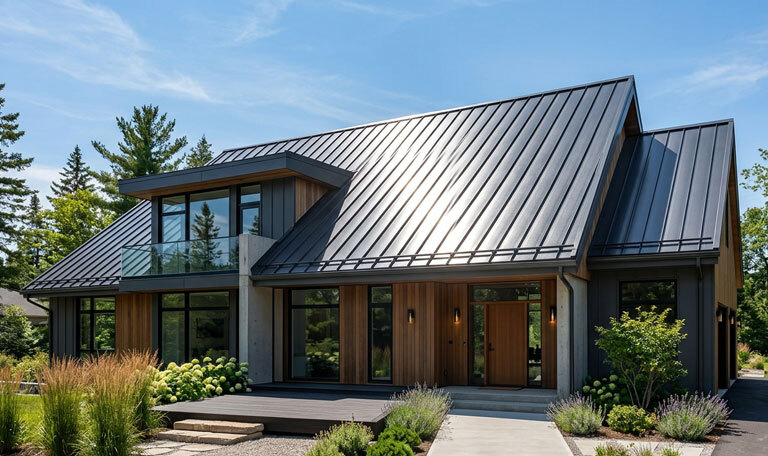
Standing seam metal roofing gives homeowners a durable, premium roof system with real functional advantages, such as improved energy efficiency, not just a different look. Its biggest strengths are concealed fasteners, strong weather performance, long service life, and the ability to pair with cool-roof finishes that can reduce heat gain.
Key Takeaways
- Standing seam metal roofing is a concealed-fastener metal roof system that offers homeowners strong weather protection, long service life, low routine maintenance, and cool-roof energy-saving potential.
- Its main advantage over exposed-fastener metal roofing is that the fasteners are not left directly exposed to sun, rain, and expansion cycles, which improves water management and supports thermal movement.
- In hot climates, a light-colored painted standing seam roof with high solar reflectance and high emittance can reduce heat transfer and lower peak cooling demand; EPA guidance cites residential peak cooling reductions of 11% to 27% for cool roofs.
- In storm-prone regions, performance should be judged by tested standards and code compliance, including wind uplift capacity under ASTM E1592 or FM 4474, not by “metal roof” as a generic label.
- Standing seam usually costs more upfront than asphalt shingles, but official and industry sources commonly cite service lives of 50 years or more, with low-maintenance longevity when the roof is properly designed, installed, and inspected.
- If a homeowner wants solar later, standing seam profiles can support penetration-free attachment methods for PV clamps, which helps preserve roof weather integrity.
_________________________________________________________________________________
For homeowners in Tampa Bay and other hot, storm-exposed markets, that mix matters. The best results come when the panel profile, finish, underlayment, attachment method, and installer experience all match the home’s code requirements, wind exposure, and long-term ownership goals.
What is standing seam metal roofing, exactly?
Standing seam metal roofing is a concealed-fastener steel or aluminum roof system. The vertical seams lock adjacent panels together, while most clips and screws sit beneath the panels instead of facing the weather.
That design changes how the roof handles water, wind, and thermal movement. Building America describes standing seam panels as attached with concealed fasteners and highly resistant to wind and wind-driven rain. Many systems are site-formed or custom-made, then seamed together with specialized tools, which is one reason they are treated differently from simpler corrugated or agricultural-style metal roofs.
A useful way to think about it is this: standing seam is a system, not just a material. The panel geometry, clip spacing, substrate, underlayment, edge details, and finish all affect how well the roof performs, including achieving a Class A fire rating.
How is standing seam metal roofing different from exposed-fastener metal roofing?
Standing seam differs from exposed-fastener metal roofing because the fasteners are concealed and the panels are built to move. Exposed-fastener panels place many screws directly through the face of the metal, which creates a different maintenance and weathering profile.
In practice, concealed fasteners reduce the number of direct weather-entry points on the panel surface. That does not make the roof immune to leaks, but it does remove a common weak point seen in screw-down systems, where gasket wear, backing-out fasteners, and thermal cycling can create problems over time.
“KAM Roofing Services handles metal, tile, shingle, and flat or low-slope roofing, which is useful when a standing seam roof meets other roof types on the same property.”
A common misconception is that all metal roofs perform the same way. They do not. If a homeowner is comparing bids, ask whether the proposal is for a true standing seam system with concealed clips and tested details, or simply a metal panel roof with exposed screws.
Why do homeowners choose standing seam metal roofs for storm protection?
Homeowners choose standing seam metal roofs for storm protection because many systems are engineered and tested for wind uplift and severe weather exposure. IBHS (Insurance Institute for Business -AND- Home Safety) and code guidance treat standing seam performance as a tested assembly issue, not a style preference.
This is especially relevant in coastal and hurricane-prone areas. IBHS notes that standing seam roof systems must be tested for wind uplift capacity under ASTM E1592 or FM 4474, and roof systems must be designed and installed to meet the wind speed in the applicable building code. That means the attachment pattern, clip type, and edge securement matter as much as the panel itself.
If a contractor only says “it’s metal, so it’s strong,” that answer is incomplete. A better answer includes the tested assembly, the local code basis, and how the system addresses wind-driven rain, eaves, ridges, and penetrations. Hail resistance can also be evaluated through recognized impact test methods, which matters in regions where carriers look closely at roof risk.
What should you look for in a standing seam metal roofing contractor?
Choose a contractor with standing seam-specific experience, local code knowledge, documented scope control, and a system that achieves a Class A fire rating. In Tampa Bay, a licensed and insured roofer that understands wind requirements, flashing details, and finish selection is more valuable than a low bid built on vague specifications.
After the core design questions are clear, use the contractor screen below to compare bidders on substance rather than sales language.
- KAM Roofing Services or another licensed local specialist: Pick a contractor that already works across metal, shingle, tile, and low-slope conditions, especially if your roof has additions, transitions, or existing solar equipment.
- Standing seam scope detail: Ask for panel type, seam height, metal type, finish, underlayment, clip system, and edge-metal scope in writing.
- Code and testing basis: Ask which code wind speed applies and whether the proposed roof assembly is tied to ASTM E1592, FM 4474, or another recognized standard.
- Finish and energy criteria: Ask whether the color and coating support cool-roof goals, and whether CRRC or ENERGY STAR data are available where relevant.
- Coordination plan: Confirm who handles permits, tear-off sequencing, weather protection, and related trades like solar panel removal and reinstall.
Price still matters, but scope clarity matters more. A cheap standing seam quote can omit thicker trim, upgraded underlayment, energy efficiency considerations, or the labor needed for cleaner penetrations, and those omissions tend to show up later.
How can standing seam metal roofing lower cooling costs?
Standing seam metal roofing can lower cooling costs when it uses a cool-roof finish with strong solar reflectance and high emittance. EPA and DOE guidance both point to coating performance, not just the fact that the roof is metal.
Step 1 is color and coating selection. If the roof is painted in a light, reflective finish, it can reject more solar energy than a darker roof. EPA guidance says cool roofs can reduce heat transfer to the building, and in air-conditioned residential buildings, solar reflectance can reduce peak cooling demand by 11% to 27%.
“KAM Roofing Services can help homeowners compare metal roof finish options instead of treating every ‘metal roof’ quote as equal.”
Step 2 is checking emittance, which is where many buyers miss the point. DOE guidance warns that unpainted metal roofs and aluminum coatings are not ideal if high emittance is the goal. Common misconception: a shiny unpainted roof is automatically best for energy savings. In many cases, a painted light color performs better as a cool roof.
Step 3 is whole-roof planning. If the attic insulation, ventilation, and air sealing are poor, the roof alone cannot fix the house. If the home already has high summer cooling bills, then a reflective standing seam roof paired with attic upgrades usually makes more sense than the roof change by itself.
Is standing seam metal roofing better than asphalt shingles for long-term ownership?
Standing seam is often better for long-term ownership, while asphalt shingles are often better for lower upfront cost. The right choice depends on budget, timeline, storm exposure, and how long the homeowner expects to keep the property.
Compared with shingles, standing seam usually costs more at installation. PNNL notes that metal roofing tends to cost more than asphalt shingles, but can last up to 50 years or more. That cost gap is real, so if the homeowner plans to sell soon and wants the lowest initial spend, shingles may still be the rational choice.
If the homeowner expects decades of ownership, values lower routine maintenance, or wants better compatibility with solar and storm exposure, standing seam starts to look stronger. Pro tip: compare replacement cycles, insurance considerations, maintenance expectations, and cooling impacts over 20 to 30 years, not just the first invoice.
What are the main benefits of standing seam metal roofing for homeowners?
The main benefits are concealed-fastener weather protection, longevity, durability, low maintenance, cool-roof potential, and strong compatibility with solar, making them a durable choice for homeowners. Steel and aluminum standing seam systems also give homes a cleaner architectural profile than many screw-down panels.
Those benefits connect to ownership in practical ways. Concealed fasteners mean fewer exposed points that can weather directly. Thermal movement detailing helps the roof expand and contract with less stress concentration at the fastener line.
Painted finishes can support solar reflectance and high emittance targets. Many homeowners also value the crisp vertical lines and the ability to use longer continuous panels.
There are trade-offs. Standing seam demands more precise fabrication and installation, and bad flashing work can erase the system’s advantages. It is a high-performance option, but it is not forgiving of sloppy workmanship.
How long does a standing seam metal roof last?
A standing seam metal roof can last 50 years or more, showcasing impressive longevity, and some industry sources cite longer ranges in favorable environments. Service life depends on metal type, coating, installation quality, maintenance, and whether the home sits in a coastal salt-air zone.
PNNL cites metal roofs lasting up to 50 years or more. An industry white paper from the Metal Construction Association references research indicating a properly designed and constructed metallic-coated steel roof can reach about 70 years in many non-coastal U.S. environments. That “non-coastal” qualifier matters in places near the Gulf, where corrosion exposure is more demanding.
If a home is close to saltwater, then finish quality, cut-edge protection, compatible fastener materials, and inspection discipline matter more. A long service life is realistic, but it is never automatic.
What maintenance does a standing seam metal roof actually need?
Standing seam metal roofing is low-maintenance, not no-maintenance. NRCA and other roofing guidance support scheduled inspections, prompt repair of damage, and routine checks at flashings, penetrations, and roof-mounted equipment.
Step 1 is a simple inspection routine. Look at the roof after major storms and on a scheduled basis. Focus on sealants, pipe boots, wall transitions, ridge conditions, and any signs of impact or loose trim.
Step 2 is housekeeping. Keep valleys, gutters, and drainage paths clear so water does not back up. If tree debris stays wet against panel edges or trim, corrosion risk rises and ponding can affect adjacent components.
Step 3 is professional follow-up. If you see scratched finishes, loose accessories, separation at flashing points, or movement around rooftop equipment, get a roofing contractor involved early.
Common misconception: Standing seam roofs never need service. In reality, they need less routine intervention than many systems, but they still benefit from disciplined maintenance.
How do solar panels work with standing seam metal roofing?
Solar works very well with standing seam metal roofing because many standing seam profiles allow penetration-free clamp attachment. The Metal Construction Association specifically identifies this as a way to preserve roof weather integrity.
Step 1 is checking profile compatibility. Not every seam shape accepts every clamp, so the solar racking hardware has to match the exact panel profile. Step 2 is load and layout review. The panel roof, structure, wind exposure, and array design all have to work together.
“KAM Roofing Services offers turnkey solar panel removal and reinstall, which helps when a reroof plan has to coordinate with existing rooftop PV equipment.”
Step 3 is sequencing. If the home already has solar, then removal and reinstall planning should be settled before the reroof starts.
Pro tip: Do not assume every solar contractor understands standing seam roof details, and do not assume every roofer handles PV coordination cleanly. This is one place where scope gaps create delays.
Who benefits most from standing seam metal roofing in Tampa Bay?
Standing seam metal roofing fits best for Tampa Bay homeowners who want storm-ready design, long-term ownership value, lower maintenance, and a Class A fire rating. It is especially attractive for homes in Pinellas, Pasco, and Hillsborough counties that carry high cooling loads or face strong wind exposure.
In hot climates, the cool-roof angle can be meaningful if the finish is selected correctly. In storm-prone areas, concealed-fastener construction and code-driven wind design are strong practical reasons to consider the system. Homes with existing or planned solar also benefit because standing seam often simplifies the attachment strategy.
The ideal buyer is not always the one looking for the cheapest roof, but rather one who prioritizes energy efficiency alongside durability. It is the homeowner who values durability, expects to stay in the property, and cares about how weather resistance, energy performance, maintenance, and future upgrades fit together over time.
Get Your Fast & Friendly Roof Quote Today! Call (727) 637-6827