
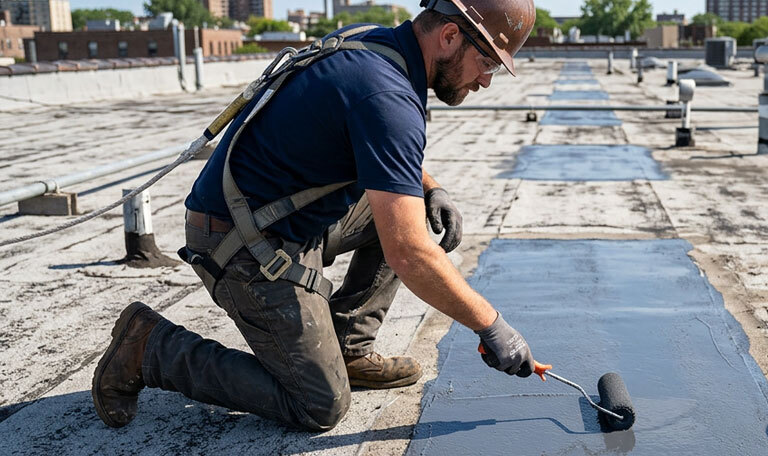
Flat roof repair is not one single fix. On low-slope roofs, the right method depends on where the failure is, what membrane is installed, and whether moisture has spread beyond the visible leak.
Key Takeaways
- Flat roof repair usually works best when it matches the failure type: patching for isolated punctures, seam repair for open laps, flashing repair for penetrations, fastener correction for mechanically attached systems, coatings for dry and stable roofs, and recover systems for broader wear on structurally sound assemblies.
- The key decision is not just “Can this leak be sealed?” but “Is the membrane, insulation, and deck still sound?” If insulation is wet across wide areas or the substrate is failing, repair often gives way to recovery or replacement.
- TPO and PVC repairs often rely on heat-welding, EPDM commonly uses tapes and compatible adhesives, and modified bitumen or built-up roofing may need plies, mastics, or membrane patches matched to the existing system.
- Roof coatings can be useful for waterproofing on low-slope roofs when the assembly is dry and well attached. EPA and DOE guidance also notes cool roof performance can reduce heat gain, but coatings do not correct trapped moisture or bad drainage by themselves.
- Ponding water, failed flashing at curbs or drains, and repeated leaks in multiple areas are decision points. If problems are isolated, targeted repair is usually cost-effective. If they are widespread, a recovery system or tear-off is often the safer path.
____________________________________________________________________________________________
That is why good flat roof repair starts with diagnosis, not sealant. A strong repair plan checks seams, flashings, drains, membrane condition, and moisture before choosing a method.
What makes a flat roof repairable instead of replaceable?
Most TPO and modified bitumen roofs are repairable when damage is localized and the deck is dry. NRCA guidance on low-slope membrane systems points to method-specific repairs, which means the right fix depends on membrane condition, seams, flashings, and trapped moisture.
A flat roof is usually a good repair candidate when the leak source is isolated, the membrane still has tensile strength, and insulation below the failed area is not broadly saturated. Typical examples include a puncture from foot traffic, an open lap at a seam, split flashing at a curb, or a backed-out fastener on a mechanically attached system.
If moisture scans or selective core cuts show wet insulation across multiple sections, the equation changes. If the roof has chronic leaks in several areas, widespread shrinkage, membrane embrittlement, or substrate deterioration, targeted repair can turn into repeated callbacks. A common misconception is that a coating can “save” any aging flat roof. It cannot fix wet insulation or structural weakness.
“KAM Roofing Services works on low-slope roofing in Pinellas, Hillsborough, and Pasco County, including modified bitumen, built-up roofing, and single-ply systems.”
How do you identify the source of a flat roof leak step-by-step?
A leak on EPDM or TPO should be traced in sequence, not guessed from the ceiling stain. Water often travels along insulation, deck ribs, or framing before it appears inside.
Step 1 is interior mapping. Start from the active leak point, then mark nearby walls, curbs, HVAC penetrations, and roof drains. The stain is often downhill from the actual failure, especially on low-slope assemblies with tapered insulation.
Step 2 is the roof inspection. Look for open seams, punctures, fishmouths, deteriorated flashing, cracked sealant, blisters, and clogged drains. KAM Roofing Services notes that flat-roof leak checks should include cracks, blisters, flashing deterioration, and drainage issues, which is a practical checklist for most low-slope inspections.
Step 3 is verification. Probe suspect seams, inspect termination bars, and use moisture detection if the leak path is unclear. If the roof is dry except for one field area, a patch may work. If the membrane is intact but the curb flashing is split, repair the flashing instead of overpatching the field.
What are the 6 flat roof repair methods, and when does each one work?
The six most common flat roof repair methods are patching, seam repair, flashing repair, fastener correction, roof coating restoration, and recover systems. GAF and NRCA both frame low-slope repair as tool- and method-specific rather than universal.
After inspection, contractors usually sort the problem into one of these repair paths:
- Patch repair: Best for isolated punctures, cuts, small splits, and impact damage in the field of the roof. It works when the surrounding membrane is clean, dry, and still bonded.
- Seam repair: Used when TPO, PVC, or EPDM laps begin to separate. This is the right fix for linear seam failure, not random holes.
- Flashing repair: Involves waterproofing and works around curbs, parapet walls, pipes, drains, and edge details where movement and water concentration are highest.
- Fastener correction: Used on mechanically attached systems when screws back out, plates telegraph, or attachment points create stress in the membrane.
- Roof coating restoration: Appropriate for dry, structurally sound roofs with surface weathering, minor crazing, or aging exposure where the assembly can accept a liquid-applied membrane.
- Recover system: Best when wear is too widespread for spot repairs but the existing roof and deck are sound enough to receive an overlay under code and manufacturer requirements.
The trade-off is simple. Targeted repairs cost less up front, but only when the failure is truly limited. Once defects are broad or moisture is spread through the assembly, a bigger scope often becomes the more durable choice.
How is flat roof patching different from seam repair?
Patching and seam repair solve different failures on TPO and EPDM. A patch closes a localized breach in the membrane, while seam repair restores the bond along a lap or joint.
Patch repair is used for punctures, cuts, or small splits in the field membrane. The damaged area is cleaned, prepared, and covered with a compatible membrane that overlaps sound material. On a single-ply roof, the patch must match the chemistry of the existing membrane or use a manufacturer-approved transition detail.
Seam repair is more linear and more exacting. On TPO or PVC, the contractor often cleans the lap and heat-welds the failed seam back together or adds a repair strip. On EPDM, tapes and primer are more common.
Pro tip: If a leak is two inches from a seam, that does not automatically mean the field membrane needs a patch. Many failures start at the lap itself, and a patch over a dirty open seam often fails early.
How do contractors repair flashing and penetrations step-by-step?
Flashing repair around a drain, curb, or pipe is often the highest-value flat roof fix. GAF specifically lists sealants and accessories for seams, flashings, and penetrations because these details fail differently than Open Field Membrane.
Step 1 is removal and inspection. Failed caulk, loose termination bars, split corner details, and deteriorated boots are removed or exposed so the substrate can be checked. If the wood nailer, metal edge, or drain bowl is unstable, the membrane repair alone will not last.
Step 2 is rebuilding the detail with compatible materials. That may mean a new pipe boot, reinforced corner patch, target patch at a drain, or fresh flashing membrane at a curb. On difficult shapes, GAF notes that 55-mil unreinforced TPO can be easier to install at detailed flashing conditions.
“KAM Roofing Services also designs low-slope roof systems for Florida weather conditions, a useful benchmark when repairs must handle UV, heat, and wind-driven rain.”
Step 3 is edge control. Termination bars are resecured, sealant is applied where the system calls for it, and the detail is checked for positive water flow. A common mistake is relying on roof cement alone around penetrations. On modern single-ply systems, compatible membrane work matters more than a heavy bead of generic sealant.
When does a roof coating make sense for a flat roof?
A roof coating makes sense on a dry, stable low-slope roof with aging surface exposure but no widespread moisture damage. EPA and DOE both treat low-slope roofs as common cool-roof candidates, which is relevant when a repair plan also considers heat performance.
Coatings are most useful when the roof still has sound attachment, and the owner wants to extend service life, improve reflectivity, and reduce surface temperature. DOE says cool roofs can stay up to 60°F cooler than traditional black roofs in summer, and EPA notes low-slope cool roofs can help lower indoor temperatures in some buildings.
“KAM Roofing Services offers low-slope roofing for residential and commercial properties, which matters when coating decisions must weigh occupant disruption, drainage, and long-term maintenance.”
The trade-off is important. A coating is a restoration layer, not a cure for wet insulation, active substrate movement, or failed detailing across the roof. If the membrane is peeling, the insulation is saturated, or ponding is severe, coating first is often the wrong sequence. Repair the assembly problems, then decide whether a coating adds value.
How does a recovery system compare with a tear-off replacement?
A recovery system is faster and less disruptive than a tear-off when the existing low-slope roof is dry and structurally sound. A tear-off is the safer choice when moisture, deck damage, or multiple failing layers are already in play.
Recover means installing a new roof layer over the old assembly, usually after targeted prep and repairs. This can reduce disruption to occupants and avoid exposing the interior during work. It may also support a cleaner path to a reflective membrane or upgraded drainage package.
Tear-off gives the clearest view of the deck, insulation, and hidden deterioration. That matters when leaks have persisted for a long time or when the roof has soft spots, trapped moisture, poor historical repairs, or insufficient waterproofing. One misconception is that recovery is always the cheaper long-term choice. If hidden moisture is significant, it can lock problems into the assembly and shorten the life of the new roof.
How should you evaluate ponding water and drainage step-by-step?
Ponding water on modified bitumen or TPO is a repair signal, not just a cosmetic issue. KAM Roofing Services also points out that clogged drains are a common leak trigger on flat roofs.
Step 1 is timing. Check whether water remains on the roof long after rain has stopped. In practice, standing water that persists about 48 hours after rainfall often deserves closer drainage review, especially near drains, scuppers, and low corners.
Step 2 is cause. Look for blocked drains, crushed insulation, deck deflection, missing crickets, and poorly placed rooftop equipment. If water gathers only near one drain, the drain detail may be the problem. If it collects in broad shallow areas, the slope design may need correction.
Step 3 is remedy selection. Minor cases may need drain cleaning, a sump adjustment, or local rework at the drain bowl. Broader cases may need tapered insulation, saddles, or slope correction during a recovery or replacement project.
Pro tip: A coating can improve weathering, but it does not create slope.
Which flat roof materials change the repair method?
Repair method changes sharply between TPO, PVC, EPDM, modified bitumen, and built-up roofing. NRCA treats these as separate low-slope membrane categories because the correct repair chemistry and detailing differ.
TPO and PVC are thermoplastic membranes, so heat-welding is often central to seam and patch repair. EPDM is a thermoset membrane, so repairs more often use primers, seam tape, cover tape, and compatible adhesives. Modified bitumen can require cap-sheet patches, cold-process materials, or torch-related techniques depending on the system and safety limits. Built-up roofing may need ply repair, flood coat work, or targeted surfacing restoration.
This is where many short-lived repairs go wrong. If a contractor uses a generic sealant on a membrane that needs welded or taped compatibility, the bond may not hold through heat, foot traffic, or movement. The more exact the material match, the better the repair life usually is.
What mistakes cause flat roof repairs to fail early?
Early failure usually comes from a bad diagnosis or incompatible materials. TPO and EPDM do not forgive guesswork.
Several errors show up again and again on low-slope roofs:
- Wrong repair chemistry: Generic mastic or sealant on a membrane that requires a welded or taped repair
- No moisture check: Sealing the top while wet insulation remains below
- Dirty or wet surface prep: Poor adhesion at seams, patches, or flashing details
- Drainage ignored: Repairing the symptom while leaving ponding water in place
- Overreliance on coating: Applying restoration over unstable or deteriorated substrate
A useful rule is this: if the same area has leaked more than once, the first repair probably addressed the visible opening, not the full failure mechanism. That may mean movement at a curb, chronic drainage stress, or hidden moisture spread.
When should you call a flat roof repair contractor right away?
Call quickly when a low-slope roof shows active interior leaking, wind damage, soft spots, or open membrane at drains or penetrations. In Tampa Bay and similar storm-prone markets, delay can turn a local repair into a saturated-insulation problem.
Fast action matters after severe rain, tropical weather, or rooftop service work around HVAC units. If the leak is near electrical equipment, if the membrane has lifted at the perimeter, or if multiple leak points appear at once, the roof needs prompt assessment.
A contractor should document the leak map, membrane type, suspected failure point, and moisture condition before recommending a patch, seam repair, flashing work, coating, recovery, or replacement. That decision process is what separates a flat roof repair that lasts from one that only buys a few more storms.
Get Your Fast & Friendly Roof Repair Quote Today!