Expert Palm Harbor Roof Repair Services

Expert Palm Harbor Roof Repair Services

A roof problem in Palm Harbor rarely starts with a dramatic failure. More often, it shows up as a ceiling stain, a patch of missing shingles after a wind event, or granules collecting in the gutter. The real challenge is not always spotting the damage; regular maintenance can help identify issues before they become major problems. It is deciding whether a focused repair will solve it for years, or whether the roof is signaling a larger issue.

That decision matters even more in Pinellas County, where roof work can become a permitting and compliance question, not just a question of square footage. A localized defect may be a smart repair. Wider wear, repeated leaks, structural concerns, or flood-related damage can push the project toward replacement or a deeper review.

Palm Harbor roof repair starts with the damage pattern

A repair is most likely to be enough when the problem is limited, recent, and clearly contained. That can mean a few shingles lifted by wind, a flashing issue around one vent, or a single impact point where a tile cracked. Guidance from KAM Roofing Services notes that a roof repair may be enough when damage is confined to a small area or a few shingles or tiles.

Pattern matters more than drama. One leak does not always mean one problem, and one visible issue does not always mean the rest of the roof is healthy. Still, when damage is isolated to one section and the surrounding roofing system is in solid condition, repair often remains the most practical option.

After a careful visual check from the ground and a professional inspection, these signs often support repair instead of replacement:

  • a few missing shingles on one slope
  • one cracked tile after impact
  • isolated flashing failure
  • minor fastener problems on a metal panel
  • a single leak source tied to one roof penetration

Roof warning signs that point past a simple repair

Many roofs give fair warning before they cross the line from repairable to costly patchwork. KAM Roofing Services identifies cracked, curled, or missing shingles as clear signs that a roof needs attention. The company also points to bare spots, split shingles, and granule loss as signs of aging. Those symptoms do not automatically mean full replacement, but they do suggest the roof should be judged as a system, not as a collection of separate little fixes.
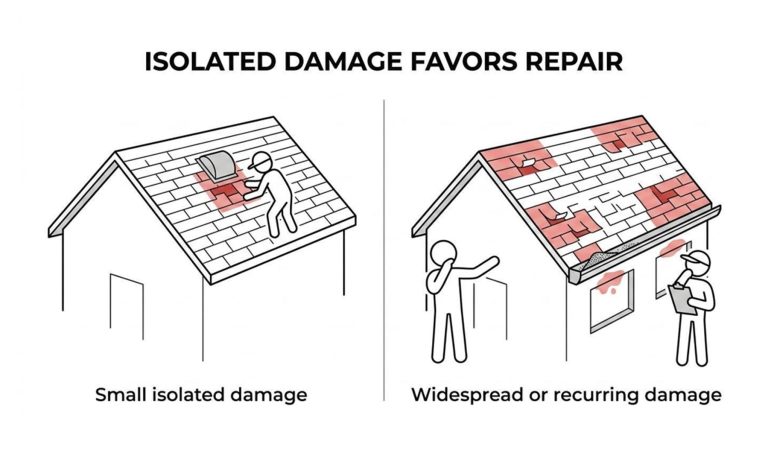
Repeat leaks are one of the strongest signals that a repair may no longer be enough. If water stains keep reappearing in different rooms, if repairs have been done more than once in a short period, or if the attic shows moisture in several locations, the issue may be broader than the visible symptom.

A roof near the end of its service life also changes the math. A repair on an older roof can stop active leaking, but it may not deliver strong value if adjacent sections are already worn down.

Roof condition

What it often suggests

Likely next step

Damage in one small area

Localized failure

Targeted repair

Missing or damaged materials in several sections

Widespread wear or
wind exposure

Full roof evaluation

Ceiling stains in more than one room

Multiple leak paths

Inspection of roof and attic

Heavy granule loss or bald shingle patches

Advanced aging

Compare repair cost to replacement value

Recurring leak after past repair

Hidden system issue

Broader repair scope or replacement review

Sagging deck or soft spots

Possible structural concern

Permit review and possible engineered plans

Pinellas County roof permits can change the answer

In Palm Harbor, a roof decision is not based only on how much damage you can see from the driveway. Pinellas County’s residential permit guidance explains that residential building permits cover most work on one- and two-family dwellings and related structures, and that permits help keep improvements safe, code-compliant, and properly documented. The county also tells applicants to select the record type that matches the project, including a specific Residential Roof record.

That matters because a contractor may inspect what looks like a straightforward repair and find conditions that require a larger permitted scope. If decking, structural framing, or major sections of the roof assembly are involved, the project can move beyond a quick patch. Pinellas County also states that all structural work requires building plans digitally signed and sealed by an architect or engineer.

A homeowner hoping for a small repair does not need to panic at the word “permit.” Minor work can still be manageable. The key is to know that code and documentation may shape the solution just as much as the damaged area itself.

A few permit-related questions can quickly clarify whether a repair is still on track:

  • Project type: Does the work fit a standard repair, or does it fall under the county’s Residential Roof permit path?
  • Structural concern: Is the roof deck, framing, or attachment system damaged enough to require plans from an architect or engineer?
  • Code compliance: Will the repaired area connect cleanly to the existing roof system in a code-compliant way?
  • Documentation: Does the insurer, HOA, or county need a clearer project scope before work begins?

Floodplain rules after storm damage in Palm Harbor

Storm damage creates another layer of review, especially for homes affected by flooding or located in flood-sensitive areas. Pinellas County’s storm recovery permitting guidance says storm repair permits will be expedited from intake to issuance unless a detailed substantial damage assessment is required. The county also says inspectors can issue permits on the spot for minor repairs and will prioritize storm-damaged homes for inspections and permitting.

That is good news when damage is modest and the repair scope is clean.

The larger issue appears when flood-related repair costs climb. Pinellas County states that if floodplain repair cost meets or exceeds 49% of a structure’s actual cash value, the home must be elevated or rebuilt to current flood safety standards. In that setting, the question is no longer “Can this leak be patched?” It becomes “Does this entire repair scope trigger a much broader compliance obligation?”

For Palm Harbor homeowners, this means post-storm roof decisions should not be made from photos alone. If wind, water intrusion, or flood effects overlap, a contractor and the local permitting process may need to sort out whether the damage remains a repair project or becomes part of a larger rebuild path.

Roof age and roof material affect repair value

The same damaged area can lead to very different recommendations depending on the roof’s age and material. A ten-year-old shingle roof with one failed flashing detail is a different case than a twenty-year-old roof with widespread granule loss. The repair may look similar on paper, yet the expected lifespan after repair is not the same.

Material type also affects how well a repair can integrate with the rest of the roof, and regular maintenance plays a crucial role in ensuring long-term performance. Matching color, profile, fastening, underlayment condition, and water-shedding performance all matter.

Shingle roof repair in Palm Harbor

Shingle roofs often lend themselves well to localized repairs when the damage is limited. A few missing shingles, a small puncture, or one vulnerable ridge area can often be corrected without replacing the full system. Once curling edges, bald spots, and repeated leaks show up across multiple sections, the better question becomes how much dependable life is left after the repair.

Tile, metal, and flat roof repair limits

Tile roofs can often be repaired when a small number of tiles crack or slip, but hidden issues below the tile, especially underlayment wear, can change the picture fast. A roof can look repairable from above while the waterproofing layer underneath is no longer performing well.

Metal roofs respond well to targeted repairs when problems are limited to fasteners, flashing, or one panel area. Flat and low-slope roofs deserve extra care because drainage problems and membrane failures may not be obvious from the ground. KAM Roofing Services advises that low-slope or flat roofs, and staining under eaves, warrant a roofing-company inspection because water movement can hide the true source of damage.

What a Palm Harbor roof inspection should answer

A strong inspection does more than confirm that there is a leak. It should identify where water is entering, how far the issue extends, whether the roof deck remains sound, and whether the visible damage matches what is happening below the surface. If attic staining, soft decking, or moisture appears in more than one area, a single repair ticket may not tell the full story.

A useful inspection should also answer whether the roofing material can be matched, whether adjacent components are near failure, and whether permit or structural review may affect scope. That is especially valuable for homeowners deciding between paying for a repair now or investing in a roof replacement with better long-term value.

Timing roof repair before hurricane season

KAM Roofing notes that hurricane season officially begins in June, and waiting until June or July to inspect or repair a roof can lead to rushed choices and limited scheduling. Emergency work after a storm is often priced higher because demand jumps.

The better schedule is simple. Check the roof twice a year, once after summer storms and once before the holidays, and arrange a professional inspection as soon as warning signs appear. Small issues tend to stay affordable only when they are handled with regular maintenance while they are still small.

Next steps after spotting Palm Harbor roof damage

  • When the answer is not obvious, a short decision process can keep the situation from drifting into guesswork. The goal is to sort the roof into one of three categories: clear repair, replacement candidate, or repair-plus-permit review.

    A practical next step plan looks like this:

    1. Document the signs: Take photos of missing materials, stains, gutters, and any interior leak marks.
    2. Ask for a system-level inspection: Request findings on surface damage, underlayment, decking, flashing, and attic moisture.
    3. Check the scope against county rules: Confirm whether the work stays a basic repair or enters Residential Roof, structural, or storm permit territory.
    4. Compare repair value to remaining roof life: If damage is isolated and the roof is otherwise healthy, repair may be the right move. If problems appear in several areas or the roof is aging out, replacement may be the wiser investment.

    That process gives Palm Harbor homeowners something better than a guess: a clear path based on damage pattern, roof condition, and the local rules that shape what “enough” really means.

    Get Your Fast & Friendly Roof Quote Today! Call (727) 637-6827

Contact Us

Request An Estimate Today

Protect your home and your peace of mind with a contractor who values honesty. At KAM Roofing Services, we are committed to “Taking the ‘Con’ out of Construction.” We provide clear estimates, detailed project timelines, and reliable operations.

Contact us today to secure your home before the next major storm hits the coast.